

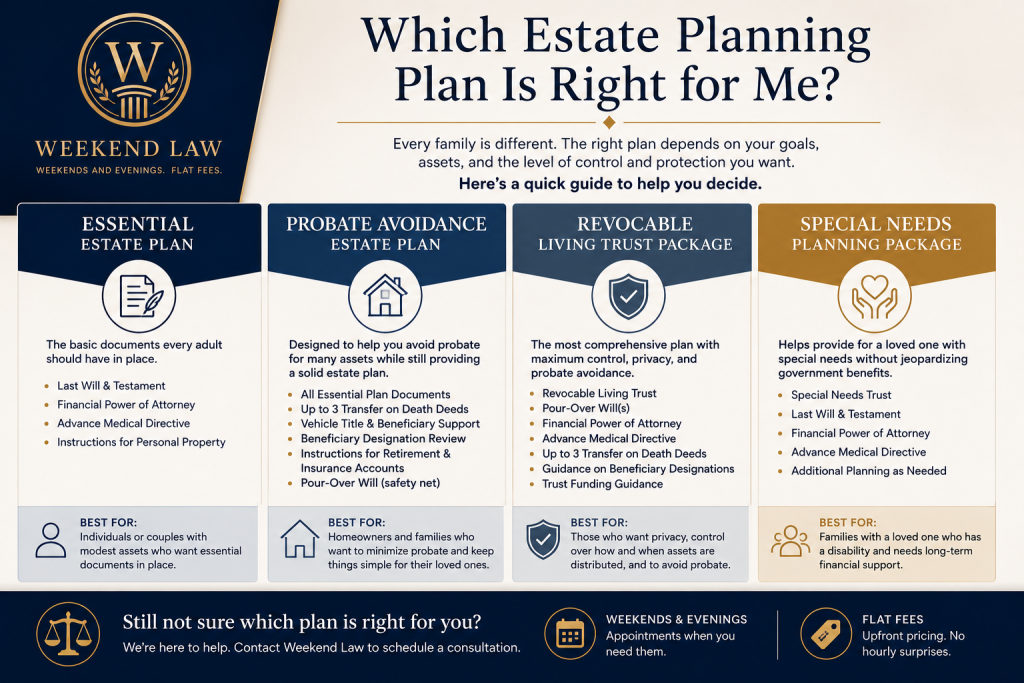
Which Estate Planning Package Is Right for Me?
Start With the Basics
Every adult should have a basic estate plan. Regardless of age, income, or family situation, most people benefit from having a Last Will & Testament, a Financial Power of Attorney, and an Advance Medical Directive. These documents allow you to choose who will handle your affairs if you become incapacitated and who will receive your property after your death. Without these documents, important decisions may be left to Virginia law, a court, or family members who may not know your wishes.
For many individuals and families, the Essential Estate Plan is the appropriate starting point. While more advanced planning may be beneficial in certain circumstances, a properly drafted will and incapacity documents provide significant protection and peace of mind. Estate planning is not just for the wealthy—it is for anyone who wants to make life easier for their loved ones and ensure their wishes are respected.
The Essential Estate Plan
The Essential Estate Plan is designed for individuals and families who want to put the most important legal protections in place. A will allows you to decide who receives your property, who will administer your estate, and who will serve as guardian of your minor children. If you have specific items that you want to leave to particular individuals—such as jewelry, firearms, military memorabilia, family photographs, or other cherished possessions—a will can help ensure those wishes are carried out.
A will can also include testamentary trust provisions for minor children. Rather than having a child receive a substantial inheritance at age eighteen, a testamentary trust can allow assets to be managed by a trusted adult and distributed at ages you select, such as twenty-five, thirty, or thirty-five. This type of planning can provide additional protection while young beneficiaries gain maturity and financial experience.
For parents of minor children, a will also allows you to nominate guardians who would care for your children if both parents were to pass away before the children reach adulthood. While a court ultimately makes the final decision, courts generally give significant weight to the wishes expressed by parents in a properly drafted will. For many parents, the ability to nominate guardians is one of the most important reasons to have an estate plan in place.
Testamentary trusts can be particularly valuable for divorced parents. Without proper planning, assets left to minor children may ultimately be controlled by the child’s other parent until the child reaches adulthood. In some situations, that may be exactly what the parent intends. In others, a parent may prefer that the inheritance be managed by a trusted family member, friend, or professional trustee rather than a former spouse. A testamentary trust can provide that additional layer of control while ensuring that the assets are used for the benefit of the child.
Understanding Probate in Virginia
The next question for many families is whether avoiding probate is important. Probate is the court-supervised process used to transfer property after death when assets do not pass automatically through beneficiary designations, joint ownership, or other planning mechanisms. Contrary to what many websites suggest, probate in Virginia is generally not as burdensome as it is in some states. However, that does not mean it is simple or cost-free.
Even relatively straightforward estates often require multiple courthouse filings, communication with financial institutions, preparation of inventories and accountings, and ongoing administrative responsibilities. Probate may also involve qualification fees, fiduciary bond premiums, newspaper publication costs, tax preparation expenses, attorney fees, and other administrative costs. In many cases, the process lasts close to a year, and it can be particularly challenging when beneficiaries or fiduciaries live outside Virginia.
The Probate Avoidance Estate Plan
For many families, the primary goal is not controlling property after death but simply making administration easier for loved ones. That is where the Probate Avoidance Estate Plan often makes sense. This package is particularly popular with older individuals, retirees, and couples whose children are already adults and financially responsible.
These clients often do not need guardian nominations or extensive trust provisions because their children are grown. Instead, they want to simplify the transfer of assets and reduce the amount of work required after death. Through the use of Transfer on Death Deeds, beneficiary designations, vehicle beneficiary designations, and related planning tools, many families can significantly reduce or eliminate the need for probate while still maintaining a comprehensive estate plan.
Probate Avoidance Without a Trust
One of the most common misconceptions in estate planning is that a trust is required to avoid probate. In many situations, that is simply not true. Beneficiary designations on retirement accounts, life insurance policies, and financial accounts, combined with Transfer on Death Deeds for real estate, can often accomplish probate avoidance without the expense and complexity of a trust.
For families whose primary goal is simply transferring assets efficiently to responsible adult beneficiaries, the Probate Avoidance Estate Plan may provide all the planning they need. The included will serves as an important safety net to ensure that any assets not otherwise transferred pass according to the client’s wishes.
When a Revocable Living Trust May Be Worth the Extra Planning
The primary advantage of a trust is not merely probate avoidance. The real benefit is control. A trust allows you to continue directing how property will be managed and distributed long after your death. For some families, that additional control provides significant advantages that cannot be replicated through beneficiary designations alone.
Trusts are particularly useful when beneficiaries may need guidance, protection, or structured distributions. Rather than receiving a large inheritance outright, beneficiaries can receive assets according to rules and instructions established by the person creating the trust. This flexibility allows estate plans to be tailored to the unique needs of individual families.
Blended Families and Second Marriages
One of the most common reasons clients choose a trust is because of a blended family. Consider a situation where a husband has children from a prior marriage and wants to ensure that his current spouse remains financially secure after his death. He may want his spouse to continue living in the family home and receive income from certain investment accounts while still preserving the underlying assets for his children.
A trust can accomplish these goals. The trust may allow the surviving spouse to live in the home for life, require the trust to pay certain expenses, and provide distributions from investment income while ensuring that the remaining assets ultimately pass to the children. Without a trust, it is often difficult to balance the interests of a surviving spouse and children from a prior relationship. Without trust planning, a surviving spouse who inherits assets outright generally remains free to change their own estate plan, remarry, or leave those assets to different beneficiaries. As a result, children of the deceased spouse may ultimately receive little or nothing from assets that were originally intended for them.
Spendthrift Beneficiaries and Young Adults
Trusts can also be valuable when beneficiaries struggle with financial management. Most families know someone who is hardworking and responsible with money, and someone else who tends to spend every dollar they receive. Parents frequently worry that a large inheritance could disappear within a few years if distributed outright.
A trust can provide protection by allowing assets to remain under the management of a trustee and distributed over time. Instead of receiving an entire inheritance immediately, a beneficiary may receive distributions for health, education, maintenance, and support, or receive portions of the inheritance at designated ages. This type of planning can preserve family wealth while still providing meaningful support.
Preserving Family Property and Family Values
Certain assets have significance that goes beyond their monetary value. Family farms, hunting property, vacation homes, military collections, heirloom jewelry, and similar assets often carry emotional importance and family history. Some clients want to ensure these assets remain within the family for future generations.
Trusts can provide detailed instructions regarding the use, maintenance, and eventual transfer of these assets. A trust may require that a vacation home remain available to multiple family members, establish a maintenance fund, or specify how future ownership decisions will be made. This type of planning can help preserve family traditions while reducing the likelihood of disputes.
Special Needs Planning
Special needs planning is often the easiest category to identify because the consequences of failing to plan can be significant. Many government benefits programs, including Supplemental Security Income (SSI) and Medicaid, are means-tested. In other words, receiving an inheritance directly may reduce or eliminate eligibility for important benefits.
A properly drafted Third-Party Special Needs Trust can allow parents, grandparents, and other family members to leave assets for a loved one with disabilities without necessarily jeopardizing eligibility for those programs. The trust can be used to improve quality of life and provide supplemental support while preserving access to benefits that may be critical to the beneficiary’s long-term well-being.
First-Party Special Needs Trusts
Not all special needs trusts are funded by parents or grandparents. Sometimes a person with disabilities already owns assets that may affect benefit eligibility. Examples can include personal injury settlements, inheritances received outright, retroactive benefit payments, divorce settlements, and certain survivor benefits or other funds that become the beneficiary’s property.
In those situations, a First-Party Special Needs Trust may be appropriate. These trusts are governed by different rules and often include Medicaid payback provisions that do not apply to traditional Third-Party Special Needs Trusts. Because these situations are highly fact-specific, specialized planning is often necessary.
Choosing the Right Plan
There is no single estate plan that is right for everyone. Some families need only the protections provided by a will, power of attorney, and advance medical directive. Others place a high value on probate avoidance and want to simplify administration for their loved ones. Still others need the flexibility and control that only a trust can provide.
The best estate plan depends on your assets, family structure, goals, and concerns. Understanding the differences between these planning options is the first step toward making an informed decision. Whether your goal is protecting minor children, avoiding probate, providing for a blended family, preserving government benefits, or simply creating peace of mind, a thoughtful estate plan can help ensure your wishes are carried out and your loved ones are protected.